
Introduction
Have you ever wondered where your salary disappears before the end of the month? You receive your income, pay a few bills, spend on groceries, shopping, dining out, and suddenly your bank balance is nearly empty.


This is where Budgeting becomes a powerful financial habit. A proper Monthly Budget Planner helps you track your income, expenses, savings, investments, EMI payments, and financial goals in one place.
Whether you are a salaried employee, student, freelancer, or business owner, Budgeting can help you build wealth, reduce financial stress, and achieve long-term goals. To make things easier, we are also providing a FREE Monthly Budget Planner that you can download and start using immediately.
What is Budgeting?
Understanding Budgeting in Simple Words
Budgeting is the process of planning how you will spend, save, and invest your money during a specific period, usually a month.
Think of a budget as a roadmap for your money.
Without Budgeting:
- Money disappears unexpectedly
- Savings remain low
- Credit card debt increases
- Financial goals get delayed
With Budgeting:
Read More
- SIP गुंतवणूक म्हणजे काय?
- CIBIL स्कोअर सुधारण्याचे 10 प्रभावी मार्ग
- गृहकर्ज घेण्यापूर्वी लक्षात ठेवण्याच्या गोष्टी
- आपत्कालीन निधी किती असावा?
- Mutual Fund vs FD – कोणता पर्याय चांगला?
- Every rupee gets assigned a purpose
- Savings increase consistently
- Investments become regular
- Financial goals become achievable
Why Budgeting is Important in 2026
The cost of living in India continues to rise due to inflation.
Common monthly expenses include:
| Expense Category | Average Monthly Cost |
|---|---|
| House Rent | ₹8,000 – ₹30,000 |
| Groceries | ₹3,000 – ₹12,000 |
| Electricity | ₹1,000 – ₹3,000 |
| Internet & Mobile | ₹500 – ₹2,000 |
| Transportation | ₹1,500 – ₹10,000 |
| EMI Payments | ₹2,000 – ₹50,000+ |
Without Budgeting, these expenses can quickly consume your entire income.
Therefore, a Monthly Budget Planner becomes essential.
Benefits of Using a Monthly Budget Planner
1. Complete Visibility of Your Finances
A budget planner helps you understand:
- Total Income
- Total Expenses
- Savings
- Investments
- Outstanding Loans
- EMI Commitments
You gain complete control over your financial situation.
2. Helps Build Emergency Savings
Financial experts recommend maintaining an emergency fund equal to 6 months of expenses.
Example:
Monthly Expenses = ₹25,000
Emergency Fund Required:
₹25,000 × 6 = ₹1,50,000
Your Monthly Budget Planner can track progress toward this goal.
3. Supports Investment Growth
Budgeting creates surplus cash.
That surplus can be invested into:
Read More
- SIP गुंतवणूक म्हणजे काय?
- CIBIL स्कोअर सुधारण्याचे 10 प्रभावी मार्ग
- गृहकर्ज घेण्यापूर्वी लक्षात ठेवण्याच्या गोष्टी
- आपत्कालीन निधी किती असावा?
- Mutual Fund vs FD – कोणता पर्याय चांगला?
- SIPs
- Mutual Funds
- Stocks
- PPF
- NPS
- Retirement Planning
4. Reduces Debt and EMI Stress
A budget planner shows:
| Debt Type | Monthly EMI |
| Home Loan | ₹15,000 |
| Personal Loan | ₹5,000 |
| Bike Loan | ₹2,500 |
This visibility helps prioritize repayments.
5. Improves Financial Discipline
Budgeting transforms spending habits.
You become more conscious before making purchases.
As a result:
- Impulse spending reduces
- Savings increase
- Financial confidence improves
Who Should Use a Monthly Budget Planner?
Salaried Employees
Track:
- Salary
- Bonuses
- Investments
- EMI Payments
Students
Manage:
- Pocket money
- Educational expenses
- Savings goals
Freelancers
Track:
- Irregular income
- Client payments
- Business expenses
Small Business Owners
Monitor:
- Revenue
- Expenses
- Profitability
Families
Plan:
- Household expenses
- Children’s education
- Retirement goals
Pros and Cons of Budgeting
| Pros | Cons |
| Better money management | Requires consistency |
| Increases savings | Initial setup takes time |
| Reduces debt | Needs monthly updates |
| Improves financial awareness | Can feel restrictive initially |
| Supports investment goals | Requires discipline |
How to Use the Free Monthly Budget Planner
Step 1: Record Monthly Income
Include all sources:
| Income Source | Amount |
| Salary | ₹40,000 |
| Freelancing | ₹5,000 |
| Side Hustle | ₹3,000 |
Total Income = ₹48,000
Step 2: Record Fixed Expenses
Examples:
- SIP गुंतवणूक म्हणजे काय?
- CIBIL स्कोअर सुधारण्याचे 10 प्रभावी मार्ग
- गृहकर्ज घेण्यापूर्वी लक्षात ठेवण्याच्या गोष्टी
- आपत्कालीन निधी किती असावा?
- Mutual Fund vs FD – कोणता पर्याय चांगला?
- Rent
- EMI
- Insurance
- Internet
Total Fixed Expenses = ₹18,000
Step 3: Record Variable Expenses
Examples:
- Groceries
- Fuel
- Dining
- Shopping
Total Variable Expenses = ₹12,000
Step 4: Calculate Savings
Example Calculation #1
Income = ₹48,000
Expenses = ₹30,000
Savings = ₹48,000 − ₹30,000
Savings = ₹18,000
Step 5: Allocate Savings
| Goal | Allocation |
| Emergency Fund | ₹8,000 |
| SIP Investment | ₹7,000 |
| Vacation Fund | ₹3,000 |
The 50-30-20 Budgeting Rule
One of the most popular Budgeting methods.
Example Calculation #2
| Category | Percentage |
| Needs | 50% |
| Wants | 30% |
| Savings & Investments | 20% |
Monthly Salary = ₹50,000
Needs:
₹50,000 × 50% = ₹25,000
Wants:
₹50,000 × 30% = ₹15,000
Savings:
₹50,000 × 20% = ₹10,000
This simple strategy makes Budgeting easier.
Common Budgeting Mistakes Indians Make
1. Not Tracking Small Expenses
Small expenses accumulate quickly.
Examples:
- Tea
- Snacks
- Food Delivery
- Subscriptions
2. Ignoring Emergency Funds
Many people focus only on investments.
Emergency funds should come first.
3. Overusing Credit Cards
Credit cards are useful but can create debt traps.
4. No Retirement Planning
Retirement planning should begin early.
Even a ₹2,000 monthly SIP can create significant wealth over time.
5. Not Reviewing the Budget Monthly
Budgeting is not a one-time activity.
Review it every month.
Real-Life Maharashtra Examples
Example 1: Pune IT Employee
Monthly Salary: ₹60,000
Before Budgeting:
- Savings: ₹2,000
After Budgeting:
- Savings: ₹12,000
Example 2: Freelance Designer from Nashik
Income varied monthly.
Using a Monthly Budget Planner helped allocate income systematically.
Savings increased from ₹500 to ₹8,000 monthly.
Example 3: Small Business Owner from Aurangabad
Tracked cash flow using a budget planner.
Identified unnecessary expenses worth ₹7,000 monthly.
Redirected savings toward investments.
Free Monthly Budget Planner Download
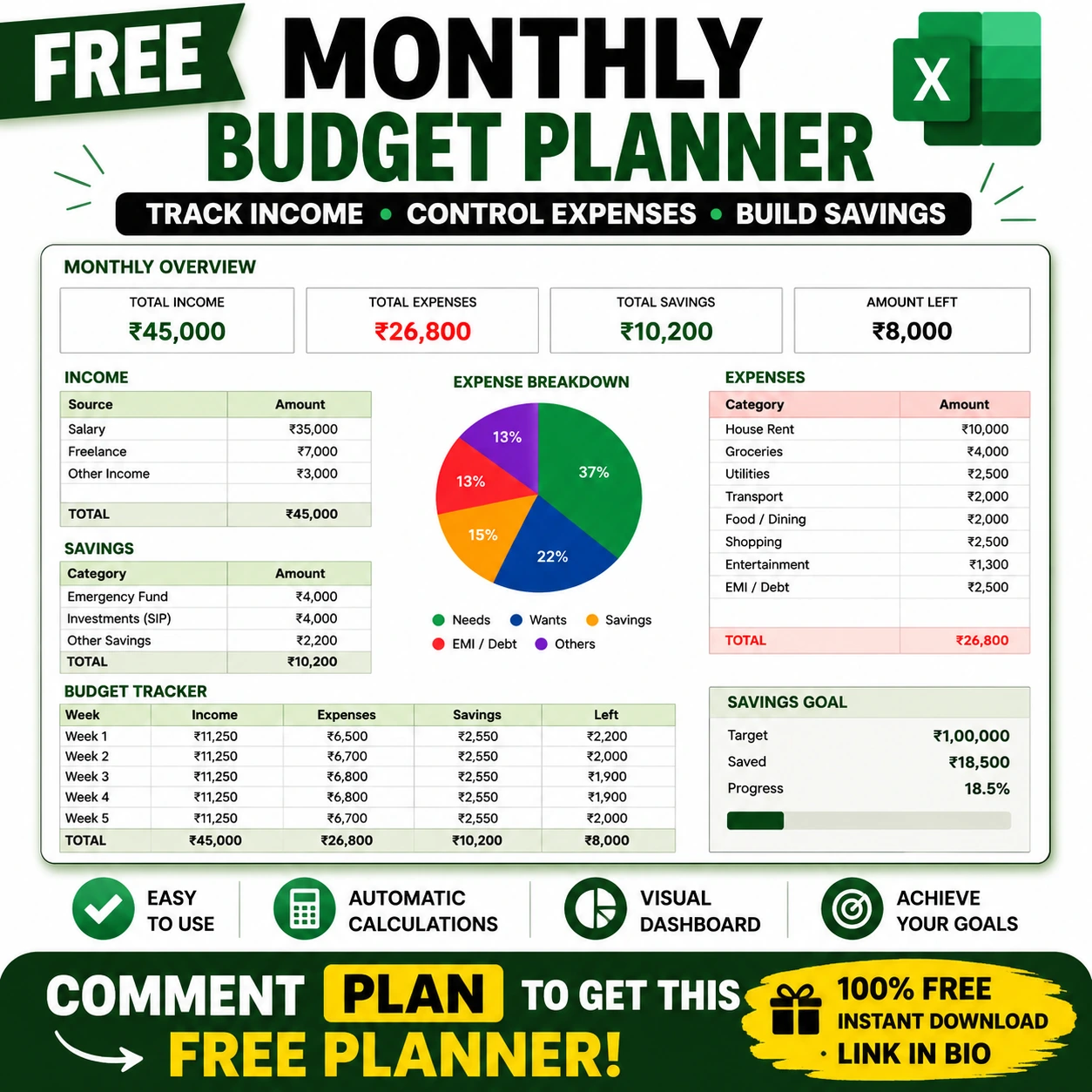
To help you implement everything discussed in this guide, we provide a FREE Monthly Budget Planner.
The planner includes:
✔ Income Tracker
✔ Expense Tracker
✔ Savings Tracker
✔ Debt Payment Tracker
✔ Goal Planning Section
✔ Monthly Financial Overview
✔ Easy-to-use Excel Format
Read More
- SIP गुंतवणूक म्हणजे काय?
- CIBIL स्कोअर सुधारण्याचे 10 प्रभावी मार्ग
- गृहकर्ज घेण्यापूर्वी लक्षात ठेवण्याच्या गोष्टी
- आपत्कालीन निधी किती असावा?
- Mutual Fund vs FD – कोणता पर्याय चांगला?
Download it today and start managing your finances more effectively.
Frequently Asked Questions (FAQs)
1. What is Budgeting?
Budgeting is the process of planning and managing your income, expenses, savings, investments, and financial goals.
2. Why is a Monthly Budget Planner important for Budgeting?
A Monthly Budget Planner provides a structured system to track money and improve financial discipline.
3. Can students use Budgeting?
Yes. Budgeting helps students manage pocket money and develop healthy financial habits.
4. How much should I save through Budgeting?
A common recommendation is to save at least 20% of your monthly income.
5. Does Budgeting help reduce EMI burden?
Yes. Budgeting allows you to plan debt repayments and avoid missed EMI payments.
6. Can freelancers benefit from Budgeting?
Absolutely. Freelancers can manage irregular income more effectively through Budgeting.
7. Is a Monthly Budget Planner suitable for beginners?
Yes. It is one of the easiest tools for beginners to start managing money.
Conclusion
Budgeting is not about restricting your lifestyle. It is about giving every rupee a purpose. When you consistently track your income, expenses, savings, investments, EMI obligations, and financial goals, you gain control over your financial future.
Download the FREE Monthly Budget Planner today, start Budgeting immediately, and take the first step toward financial freedom. Your future self will thank you for the decision you make today.
